Wednesday, 9 July 2014

13. Owl, Pig, Bear and the children

There are so many stories milling around in my head, waiting to burst out.

Profound stuff, like musings on Body image and How your life story affects your cancer story.

Interesting stuff, like What (not) to say to a cancer patient and What makes a helpful doctor/nurse.

Mundane stuff, like How an errant Softie can make you look like a Picasso painting and When should I go back to work?

Backdated stuff, like How did I find the cancer? and How did the children react to the news?

But I mustn’t overload you or keep you from your work/shopping/bedtime. I decided that it’s time to put first things first. So the next few blogs are going to be about Owl.

First up: How Owl has helped my children.

Almost as soon as I had given my newly stitched Owl cancer, I became aware of his huge potential as my personal therapist. But that wasn’t the original intention.

Owl was given cancer in order to help my daughters.

You will need to put this into the context of our family life.

Projecting events, feelings, emotions and opinions onto a soft toy is nothing new in the Tuffrey household. The men have excused themselves from this perhaps rather bizarre phenomenon, but I freely admit that I have entered into it with gusto.

My now 14 year old daughter has Pig, who has joined in with everything for over 13 years. My 11 year old daughter has Bear, who is 7. He, too, is always there for her.

Bear and Pig have their own school uniform. They come on holiday with us. They cry at films.


Giving them a voice may have been my fault, as I used to talk for Pig before my daughter could speak. As soon as Pig could begin to use her voice, he would only ever speak in Dutch (even though my daughter always spoke to me in English). I think that was because Pig spoke Dutch when he used my voice, so she must have thought he couldn’t speak English. (He can now.)

I am delighted that Bear and Pig are still going strong even though their owners are now teenagers, and I secretly hope that they will visit me even when my husband and I are in a nursing home for the elderly.
  
I can highly recommend giving children a deliberate alter-ego like these two animals.

It has enabled them to express difficult emotions. It’s much easier for a Bear to say “sorry” for misdemeanours than it is for a young girl.

When my older daughter had just started primary school, she came home with the news that she’d had a horrible lunch. Didn't they have nice things to eat? Well, yes, but she hadn’t dared ask the dinner lady for what she wanted (so was given a ladle full of yuk).

“Oh dear, that's awful,” I said. “I wonder what Pig would have done?”

“He would say very loudly I DON'T WANT THAT, I WANT THIS!” she said.

“Well,” I suggested, “next time you get given something you don’t like, why don’t you pretend to be Pig?”

She did, I think. Pig has made her braver.

So over the years, my daughters have learnt that you can use external aids to understand and express your feelings. Pig is mostly retired now, but his help has been, and often still is, invaluable.

It was in this family context that I decided Owl should mirror my cancer journey.

My children are old enough, of course, to understand what is happening to me without the help of Owl. It has been unexpectedly useful, however, to put Owl through everything I’ve gone through.

There has been the MRI scan and the heart test and the hospital admissions. He has shared my trials and tribulations through bandages, scars and markings.


Owl and I, marked up for the lumpectomy,
and with a plaster where a radio-active dye injection had been given
(to light up the key lymph node during surgery)

In fact, Pig has come out of semi-retirement to take on a new incarnation in recent months. He now fancies himself a Cancer Support Nurse to Owl.

As soon as I have to go through something difficult, my older daughter says cheerfully, "Hang on a minute, I must get Pig! Owl needs his Cancer Support Nurse." 

(“I don’t know much about cancer. Sorry,” Pig has admitted. “I'm not a very good nurse. I only know how to do support. I can give hugs.”)

In the same way that it is easier for Bear to say “sorry” than it is for my daughter, it is much easier for me to say “Owl is feeling sad about losing his wing” than it is to say “I am feeling sad about losing my breast.”

In fact, Owl made it surprisingly easy to tell my younger daughter that I needed a mastectomy. (For my son and older daughter, grown-up explanations and discussions were more appropriate).

I was shaky and upset about this news. I felt very strongly that all three children had to be told as soon as possible. I spoke to each of them in turn as they came home from their respective schools.

All I had to do was put Owl prominently on the kitchen table, and tell my younger daughter that Owl needed to go back into hospital, because the doctor had discovered more cancer in his body.

Of course, she knew immediately that this news was really about her mother. Owl has enabled questions and discussions about this.

My younger daughter seems utterly reassured by the fact that I have an Owl to keep me company throughout my treatment. It is quite wonderful to see how through Bear’s care and concern for Owl, she is able to express her own care and concern for me.

Miraculously, I am now able to help her understand that adults have worries too, without it being distressing.

I don’t think it would be right for my children to worry that their mother is anxious or frightened. Somehow, having these emotions contained in a small fabric owl makes them manageable and acceptable.

I have been profoundly moved by my younger daughter’s unspoken insight into all of this.

One day, when I was getting ready to go to a hospital appointment, she reminded me: “Mum, do you have Owl?”

I had almost forgotten him, so I went to get him and held him up before putting him into my handbag, making him quiver.

“Look! Owl is a bit frightened about going to the hospital. He is worried about what the doctor is going to say.”

She rushed over to him, arms outstretched, eyes full of compassion. She took him out of my hands and kissed him all over.

“Oooohh, don’t you worry, Owl!” she said. “Your mummy is frightened too. So you are not alone.”

The get-well-card my younger daughter made for me and Owl

Monday, 7 July 2014

12. Scars in the swimming pool

Hurray! I’ve been swimming!

A mere 15 minutes and a gentle 20 lengths, but still, this is progress.

I am well aware that July is going to be my best month this side of 2015, physically. I have no idea how chemotherapy will affect me. It’s completely different for each person, apparently – hence my determination not to read any more grim first-person-accounts of fellow patients, lest my courage fails me.

But I cannot imagine it being a walk in the park. Or a swim in the pool, for that matter. So I’ll be trying to clock up as many walks and swims as possible before the avalanche of chemo side effects.

In an attempt to answer your How are you? question, here is the physical update.

I am still very tired, but I am also beginning to make an effort to rise from the sofa and do things. I plan them carefully, because I know I cannot do more than a few things each day. These things have recently included cooking evening meals, walking to the school gate and the supermarket, a 20 minute bike ride to the hospital (although cycling, I have always felt, doesn’t really count as exercise, because you can sit down whilst you’re doing it), playing the guitar and singing into the church microphone (I was rather pleased with that effort yesterday) and, having failed to attend any rehearsals, being an appreciative audience of my choir’s concert on Saturday night.

I can do these things again. I can pretend to be normal, at least for an hour or two. That’s a lovely feeling. It tires me out and I have to rest a lot before and after, but it is nice to feel that I am building up some slow strength.

Swimming was missing from this list. In recent years, I have established a habit of going to the pool several times a week (as well as starting Pilates classes) in order to cope with a sedentary job and a dodgy back.

I defied my breast care nurse’s advice following the lumpectomy (“Better not do swimming yet, that’s far too strenuous. Stick with walking”) and was back in the pool two weeks after the operation. My energy levels were boosted instantly.

So I was rather disappointed when I was visited by a hospital physiotherapist, the day after the mastectomy, who told me that my right arm should avoid any weight bearing exercise for at least six weeks. (“Oops”, I said, as I’d just pulled the heavy bedside table towards me. Well, what else could I do? It was on that side of the bed, it had my tea on it, and turning over to use my other arm was too painful.)

“Swimming?” I asked hopefully.

“No swimming,” she warned. “That puts far too much strain on the arm.”

The issue, apparently, is the avoidance of lymphoedema.

I have had many patients with lymphoedema during my hospice days, and it is not to be envied. This harmless but extremely uncomfortable arm swelling can happen to women who, like me, have had the lymph nodes under their arm removed. The lymphatic fluid in the arm can navigate its way around this problem, but if there is too much of it, the system becomes overloaded and the arm swells alarmingly. Once this starts, you’re scuppered for life.

It has been my biggest fear (well, apart from the minor matter of finding more cancer cells in my body, and dying as a result). I am worried about living a future with a swollen arm and hand, which would interfere with my ability to play the cello, sew more owls and wag a finger at my children.

So I’ve been very careful to exercise my right arm gently, encouraging the lymphatic fluid to be pumped back nicely. I have also been very careful not to overload the arm, not to get any cuts or grazes or insect stings or sunburn (which would send extra quantities of lymphatic fluid rushing to the scene, with its infection-busting properties). I hadn’t realised that strenuous exercise also increases the load of lymphatic fluid.

Thankfully, I have friends and colleagues who are either experts in cancer, or who can beat a quick path to such experts. One of my work contacts asked a nurse consultant in the lymphoedema clinic of a major cancer centre, who sent a reassuring email:

"It is absolutely fine for Irene to go for a gentle swim as long as the wound has fully healed. [It has.] Swimming and any movement in the water is not weight bearing and will encourage lymph drainage, but I would advise against anything too exertive and to 'listen' to her body."

I am not looking for a third opinion. I tend to stop looking once I've found the advice that suits me. A gently swim will suit me nicely.

So here is the next question: What to wear in the swimming pool?

I had pondered this before. Apparently there is a whole world out there, titled “mastectomy swimwear”, but I had already decided that I wouldn't bother with it.

This dismissal is possible because I am not blessed (or burdened, as the case may be) with anything more than an A-cup, so I won’t have vast quantities of redundant fabric flapping around my chest. Furthermore, my swimming costume is made for swimming, not for sauntering along the sea shore. It tends to streamline any A-cup into oblivion, so my thinking was that the difference between left and right would be a mere blip on the surface.

Still, I hadn’t tested this theory, so I put on the swimming costume last night and went in search of an opinion. I found my husband and my older daughter hanging out the washing and groped my way through the wet sheets, emerging on the other side: “What do you think?”


My older daughter was puzzled. “What do you mean?” she asked, in a way that said “What’s so new about that costume? You’ve had it for years.” Which was promising. I think we are all getting used to my new shape, and are already beginning to be blind to it. Or perhaps it was due to the disguising properties of swirly patterns?

Once the issue was explained (“Well, look, it’s flat here”) they both thought that it was definitely noticeable but people were unlikely to stop and stare.

“Except children,” my older daughter thought. “They will notice.”

I thought about this, and asked: “Well, so what?”

My older daughter shrugged her shoulders. “They’ll just look at it, that’s all.”

For completeness, I checked with my younger daughter before setting off to the pool this morning. She clearly belongs to the above-mentioned “children” category, because she did indeed notice.

“Mum, you can see the scars,” she said disapprovingly.

(You can. I'm sure you've spotted them too. There are two: a long one from the mastectomy-and-lymph-node-clearance-surgery, and a short one above it, courtesy of the initial lymph node testing.)

“Yes, well, never mind about those. What if I didn’t have any scars?”

“It looks flat,” she pronounced.

“Does it matter?”

“Yes! It looks weird.”

For all of three seconds, I considered bringing my Softie along. Then I remembered the story of a friend, about someone whose breast inserts floated away from her in the pool. Given the expert’s warning that I shouldn’t swim with too much exertion, I decided that racing to catch up with an errant fake breast was probably inadvisable.

Quite apart from the untested properties of wet Brain Fluff, which could, I feared, mimic those of the gravity-sensitive, hand-knitted swimming trunks of my toddler years. (Whenever Bear has a bath, his fluff gets so heavy that it needs two of us to haul him out. I might sink, swimming with my Brain Fluff Softie.)

I also remembered how upset this very same daughter had been when (a) I had braces put onto my teeth (I don’t want an ugly mother!) and (b) the braces were removed from my teeth 18 months later (You don’t look like mummy anymore!).

So off I went to the pool, breastless.

It was bliss. I couldn't see properly without my glasses, but I don't think anybody stared. If they had, I wouldn't have cared.

Well, for the sake of honesty: I probably I would have cared, but I think it would also have made me even more determined to get used to it. I made a point of using the public rather than the private showers. In at the deep end. I am planning to go swimming every morning from now on.

Now all I have left to ponder is whether I will need my swimming cap when I’m bald.

I’ll get back to you on that one.

Saturday, 5 July 2014

11. How are you?

I have been asked this so often in recent months that by now, I should be a dab hand at answering.

But How are you? is a hazardous question, both for the inquirer and for me.

This, I have come to realise, is because it has so many different meanings, requiring me to select the correct answer from a range of possibilities. The hazard lies in the risk of a question-answer mismatch.

At one end of extremes, there is Hi, how’r YOU?

This is usually spoken quickly and accompanied by a cheerful smile (if the questioner even looks at you, that is). The average Englishman is an expert at this one. Shopkeepers excel at it. (I’ll give you an example in a minute.)

The correct answer to Hi, how’r YOU? is: I’m fine thanks. Isn’t the weather lovely? But what a shame England is out of the World Cup.

At the other end, there is Hello! How AAAAARE you?

This is usually spoken slowly and with a frowning half-smile that says I know exactly what you’ve gone through, and I’m ready for your long and considered response. Tears are fine, by the way, I’ve got a spare Kleenex.

The correct answer here is: Let me put the kettle on and I’ll tell you all about it. Have you got a spare 45 minutes as well as that spare Kleenex?

In-between, there are all manner of variations, and their meanings are not always easy to discern.

There is How ARE you? spoken fairly deliberately but somewhat nervously, with the questioner not daring to smile. I sense that they fear an honest answer, and they worry that they might not even have enough Kleenex for themselves, let alone for me.

The correct answer in this situation is: I am fine, given the circumstances. And how are YOU?

Then there is How are you (recovering from the surgery? Has your scar healed yet?)

And How are you (coping with the requirements of daily life?)

The trouble is, How are you? is, in England, just a conversation starter. And people no longer dare to just talk to me about the weather.

How are you? is a light-hearted question, so both of you can clear your throat and test your voice before moving on to the real conversation, which can range from That’s £12.99 please to Have you heard so-and-so is getting married?

But now, everyone knows that the standard I’m fine thanks is not going to work when they ask me the question, even if they do the quick-with-a-smile version. My blog, which seems to be read even by people I don’t usually stop to chat to, has helped to ensure that everyone knows I am definitely not fine right now.

Some people dare to acknowledge this, asking the question with an apologetic smile that says: Well, I’m asking, but I know the answer. Sorry.

The complication is this: very often, I actually DO feel fine.

I know I am not well, I am exhausted and my arm hurts when I lift it and my chest feels tight and bloated and I miss my mother – but I also know that I am fundamentally OK. There are many moments in the day when I feel genuinely happy. Blessed, even. Savouring the luxury of a morning spent in silence, getting up slowly, having breakfast slowly, sitting down for my daily meditation and breathing slowly, taking my time over everything. The sun is shining. I am not worrying about a lack of meals (which have been appearing on my doorstep, freezer-bag shaped, like a miracle) or a lack of love. Most of the time, I feel that cancer affects only my outside, not my inside.

There are some people close to me who know and understand this. These are the people who can genuinely ask How are you? and I can simply answer I’m fine, or I’m not fine, and they know that it is true. (They also know that the answer could flip within minutes.)

But that kind of understanding only comes from intimate friendship or kinship, and of course most people cannot fall into that category. It would be utterly exhausting to have more than a handful of such intimate relationships, as well as utterly undesirable, because it would leave me without my edges and boundaries. I would lose myself.

So you, my friend, are left with hazarding How are you? and hoping that my answer matches both your mood and mine. By all means, don’t stop asking. It’s the lubricant of British communication.

It is the people who stop asking or saying anything, fearing their own words or mine, that upset me more than any unfortunate question.

But I cannot promise a perfectly matched answer.

There have been many times when I knew that someone was ready to hear the 45 minute response, and I knew that they would have been an excellent listener, but actually, I wanted a bit of a break from Talking About Life. So what they got was I’m fine. That’s a lovely dress you’re wearing, by the way.

The opposite has also happened, however hard I have tried to prevent it.

There was the woman at the till at Gatwick Airport, for example. I was there for the second time within a week. I was on my way to my dying mother. I should have had my mastectomy a few days earlier, but I had quite literally pushed the cancer problem aside.

I could feel my skin prickle with tears trying to find a way out: that bizarre feeling that everything around me was so very clearly outlined but I was not part of it. (I really wasn’t. It was bustling with excited and scantily dressed holiday makers.) I thought I’d abate my restlessness by the useful activity of buying a pair of clip-on sunglasses that I needed for the car.

Hellooo!! How are you FEEEELING today? The till woman smiled broadly as she scanned my purchase, using an “isn’t this a very jolly place to be” kind of voice.

I tried. Honestly, I did. I’ve lived in Britain for three decades; I know the drill. I tried to put on that smile and drag up the required I’m very well, thank you. But what I heard myself say was a mumbled and glum Hmrhrgr… you DON’T want to know...

Undeterred, the till woman breezed: Going anywhere nice on holiday?

I battled on. Eehhh… no, not really…. (Please, I thought, please take the hint, or you are in actual danger of being told my life story, and that would interfere with your enjoyment of lunch).

I thought I’d escaped, until she called loudly to my retreating back: Well, have a WONDERFULtime! I hope you REALLY enjoy it!

It shattered my defences. I cried all the way to the gate. At least I now had a pair of sunglasses to hide my distress. Perhaps it was these summery sunglasses that had been misleading. Next time I can’t cope with How are you? at the till, I’ll make sure I throw in a box of paracematol.

Thursday, 3 July 2014

10. Sudden Collapses in Public Places

What a brilliantly titled collection of poems by a woman with breast cancer. When I heard of it last week, I wanted to stand up and applaud, because that is exactly what happens: sudden collapses in public places.

If you've followed this blog, you'd be forgiven for thinking that I've sobbed my way through the past few months. In truth, I usually look (and often feel) fine, which confuses and even troubles my friends.

It's OK to cry! they say, encouragingly. You don't have to be strong all the time! If ever you want to talk... (and, by implication, weep and wail on my sofa...)

The thing is, I cannot book my emotions into the diary like that.

Yes, I often suppress them in order to cope with daily life, but I also know that tears must find a way to the surface lest they drown my insides.

I do try, looking forward to having that time of quiet solitude or meeting that wonderful lifelong friend, stacking up on the hankies in anticipation. But when it comes to it, I find that I am either too tired to talk or cry, or that I am looking at my trials and tribulations with genuine laughter (because honestly, life does often look rather ridiculous at present).

The tearful collapses spring up on me when I'm not looking.

They come at moments when I think everything is under control, I have accepted my lot, I am OK with it.

I. Am. OK. Really. I. Am.

And then something happens - a snippet of a thought, a snatched piece of music, a kind gesture, an unkind gesture, a tiny insignificant setback that seems large and unsurmountable - and there I go. It can happen anytime, anywhere.

There I was the day after my diagnosis, in the office, trying to get a research funding application sent off before I was being sent off for surgery. Wandering the corridor, clutching a form that needed filling in, look, I am competent still, I am doing forms. Can't you see me smiling?

"What are you doing with that form?" a colleague asked sternly, whisking it out of my hand. "You are NOT doing that. Give it to me, we will do it for you."

"Oh," I said.
"OK," I whimpered.
"Thank you," I whispered, admitting defeat, in sudden tears.

There I was, yesterday, at a school music concert. Merrily chatting to one of the mums, until she said how she, and lots of other school mums, would be more than happy to keep me supplied with healthy meals once I'm laid low with chemo. It was only a small collapse, but it was very unexpected, very sudden and too public for my younger daughter's comfort.

But my most spectacular collapse in a public place happened in a shop in Holland, the week before my mastectomy and shortly before my mother died. It makes me smile every time I think of it, and the story gets pulled out of the bag every time a friend worries that I am being "fine" far too often. It went like this...

"What are you planning to wear to the funeral?" my sister asks.

Ah, well, I’ve already got my outfit, it’s in my suitcase, tights and handbag included. But of course things have changed. My mother disapproves of the idea of dying so much that she is taking her time over it, so I will have to carry the dress and the smart shoes back to England. I am now looking at a post-mastectomy funeral. 

Is my lovely dress going to be too close-fitting and revealing? 

I have had to pack quickly, but given enough time, I would have gone shopping for something new. My sister wonders about something with roses. That had crossed my mind too. My mother has always loved roses. ("Don't let anyone bring chrysanthemums to my funeral!" she has been threatening me for decades. "I hate them! I'll get up from my grave!")

Given enough time? Unexpectedly, there seems to be enough time now, with my mother in no rush. Almost in unison we pronounce: 

"Truitje Kopen!"

Truitje kopen. Literally: "buying a jersey", but that doesn’t do justice to the idiom it has become for us. In a very distant past, when my sister was going through a challenging exam period, her tutor suggested that Truitje Kopen was the perfect antidote. If your mind is sufficiently overloaded, the extravagance of splashing out on a top that you don’t really need is fully justified.

Let’s call it Top Shopping.

If ever there was a need for Top Shopping, this is it.

Briefly released from weeks of worry, we hit the shops in a somewhat giggly mood, like absconding school girls. We have no idea what we are looking for. Shirt? Dress? Jacket? Skirt? We walk into the first clothes shop we come across, "for inspiration" we tell each other, because clearly this is the Wrong Shop. We would never otherwise contemplate going into the kind of establishment that exudes Mature And Dignified Ladies.

Within minutes, however, my sister hits on the perfect jacket. White roses embossed on a dark background. We discuss colours, sizes and availability with the shop assistant, who enthuses: Lovely jacket! So handy, goes with anything, jeans, skirt, you can wear it to any occasion… parties... or how about this one… 

In order to put a stop to a string of unsuitable rose-free suggestions, my sister explains: "Actually, we are trying to find something to wear to my mother’s funeral. She’s not dead yet but we’re getting ahead… It’s got to have roses because her name is Rosa and she loves roses."

"Oh I’m so sorry," says the stricken shop assistant. "That’s given me goose pimples all over."

We reassure her, smiling cheerfully: don’t worry, it’s all fine, we are ready for this. (Because we are. We think we are.)


Whilst my sister goes off to pay for the jacket, I idly leaf through the racks.

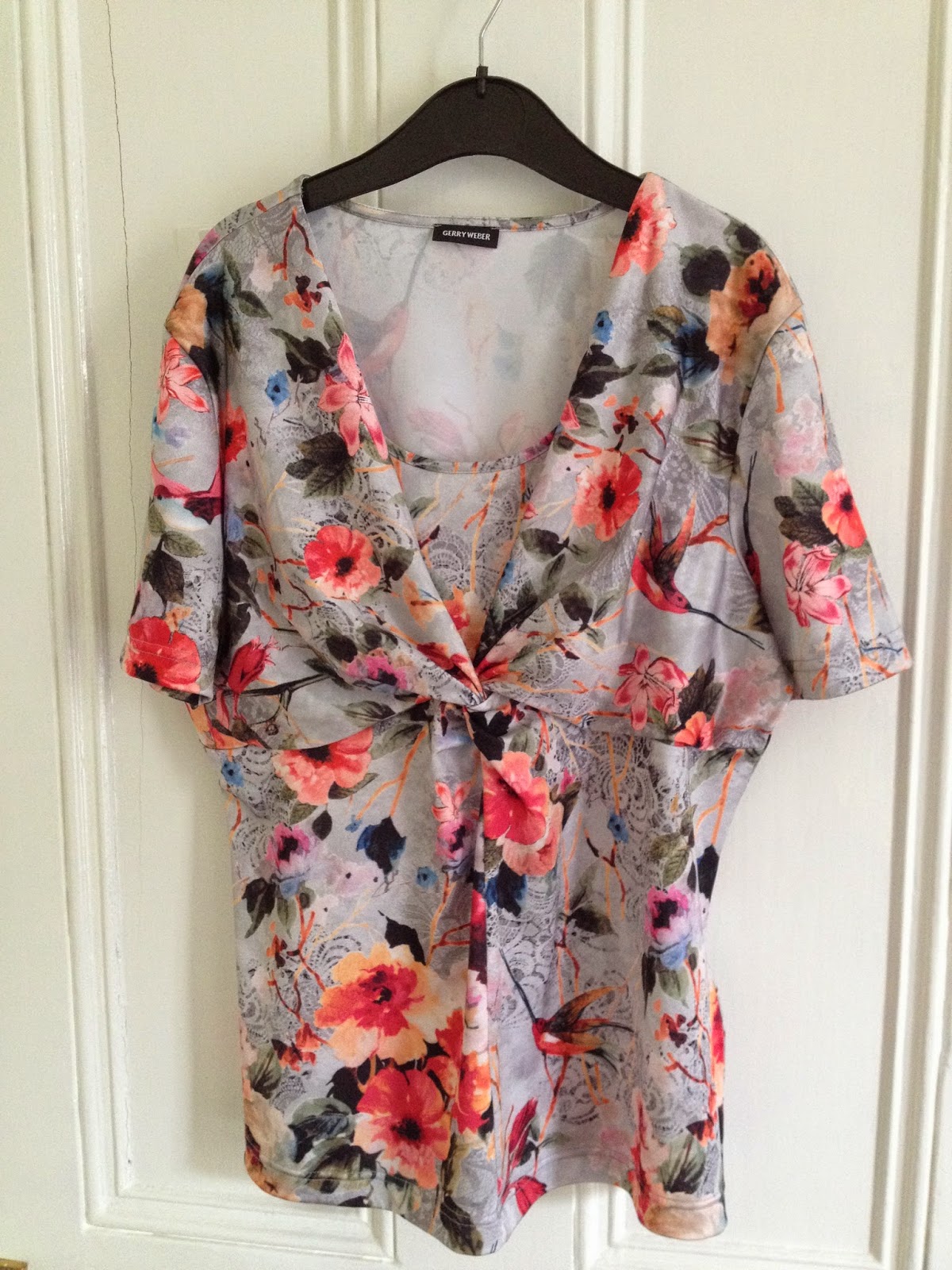
Suddenly, there it is. My funeral top. It’s not just perfect, it has been made especially for me on this occasion. Beautiful fabric, just the right colours, lovely rose pattern: my mother would have adored it. 

And it’s exactly my style, but with a twist. This top shows rather less cleavage and has an extra, flattering piece of fabric that loosely covers the breast area.


I grab it off the rails and run into the fitting room because there are sudden tears rolling down my cheeks. Here is a top that is not just perfect for my mother’s funeral but also for covering a fresh mastectomy. 

I may announce to the world that I have accepted the loss of my breast before it’s even happened, but this vivid, tangible evidence of what awaits me forces me to look at it with too much honesty.

I can hear a voice in the shop, "I just need to find my sister, I’ve lost her." I wave a feeble hand through the curtain, "I’m here," and my sister rushes in to find me slumped on the floor wearing the perfect top, dissolved in tears.

It's not just a metaphorical collapse. It is an actual collapse. My skeleton simply refuses to hold me upright.

She drops her bags, staying with me. No need for words. She understands immediately why this is such an emotional find.

The shop assistant can hear me sobbing and thinks she also knows why I am crying  – but of course she literally only knows the half of it. She peeks in, helpless: "Can I get you a glass of water?"

My sister points at the puddle I’m making on the floor. It actually makes us laugh whilst almost choking on tears, because this is just utterly ridiculous. These are tears of someone who never ever cries properly in the company of others, let alone sitting in a crumpled heap on a shop floor, let alone in sufficient quantities to cause a slipping hazard. For good measure, I add a bit more to the puddle. Might as well do things properly now that I'm at it.

I don’t even check the price tag. We take a deep breath, get the hanky out (I make sure I take it everywhere these days, as I never know when I might suddenly need it) and smile at each other, heading for the checkout. Pfff, what a state of affairs we find ourselves in. You couldn’t make it up.

The shop assistant is visibly moved by our shopping requirements and makes noises of sympathy and understanding.

I can’t help myself. I start to say "And that’s not all…" but I catch my sister’s eye. She’s shaking her head and she is right. What could the shop assistant possibly do with my bit of information, except feel even more miserable? I bite my tongue, I pay, we leave.

Afterwards, we sit down on the grass eating an ice cream (plenty of time on our hands, this was the most efficient Top Shopping ever), laughing and laughing. That poor woman, she’ll never be able to sleep tonight... it was bad enough having customers who are looking for something to wear to their mother’s funeral without me saying Oh and by the way, it also has to cover up next week’s mastectomy.

"Truitje Kopen" will never be the same again among our idioms. 

Exam stress is nothing compared with this. Top Shopping has definitely gained in status and significance.

And we didn't have to wait long to wear the new tops. Clearly, my mother approved. Less than two weeks after the mastectomy, I packed a new suitcase, this time with a rosy outfit.
My sister and I, following my mother's coffin out of her room

Tuesday, 1 July 2014

9. How Owl got cancer

My humble Owl has been waiting patiently in the wings of this blog, clutching a stack of stories. He kept being upstaged by more pressing matters. Test results, funerals, that kind of thing.

Time to start telling you Owl’s story. He has, after all, been the inspiration for this blog.

For the first story, let me take you three months back in time.

The day after telling my children that I had cancer, I promised my older daughter that we would definitely buy that overlock sewing machine we’d both been coveting, because I was going to spend a lot more time at home in the coming months.

It will help me, I thought, to sit in my own little world making clothes and owls, letting my mind wander a little but never too far: sewing requires a gentle focus and constant important decisions about fabrics and stitch length.

Some of Owl's ancestors

 “You should make owls with cancer!” my older daughter exclaimed.

Cancer?

“Yes, you put a little piece of cancer inside them.”

“Hm,” I said, “I was actually thinking of giving the owls away, and I’m not sure people would want to be given an owl with cancer.”

“I know!” my younger daughter joined in. “You take the cancer out again. Like an operation.” (The day before, I had explained to them that the surgeon will have to cut away my cancerous lump).

“Yeah,” said my older daughter, warming to the theme. “Like an operation. Then you can have an owl with a scar.”

I could see where this was coming from, and I could see where it was going.

My daughters each have their alter ego, their life’s companion, a toy animal that is no longer just a stuffed toy but a fully-fledged member of the Tuffrey family. They live, learn, experience, experiment, express their emotions through Bear and Pig.

Bear and Pig
(must have been a formal occasion)

It seemed they were suggesting that I needed just such a companion.

“It will be therapeutic, mum, if you give him cancer,” my older daughter said.

I had just been contemplating that the one truly unhelpful thing people could do is to give me advice (“You should go and have counselling”. “You should go private so you don’t have to wait for a scan.” “You should stay positive.”)

There was nothing anyone could suggest that I hadn’t already considered myself, and dismissed for good reasons. (Staying positive? Ah, good idea, hadn’t thought of that one. Thank you very much indeed.)

But I made an exception for my daughter. Her suggestion was so startling, I would never have thought of it myself. Sitting down to rig up a quick owl at the weekend, I thought: well, why not? It’s their idea, it may help them.

Having stuffed my newly stitched owl, I took a small rough piece of stone and buried it deep inside his fluff.

And suddenly, unexpectedly, I wept and wept all over my lovely owl.


Poor Owl! I thought. He looks so nice, he seems fine, but he isn’t, he’s got cancer.

And at the same time: Darling daughter, you’re a genius. You were right. Giving my owl cancer is therapeutic.

I dried my eyes and took the almost-finished owl to the girls.

If it helps me, I thought, it’ll help them.

“Here you are,” I said. “Here’s my new owl, but he’s got cancer.”

“Has he?!” They were both excited.

“Yes,” I said, “and someone needs to take it out.”

My younger daughter was ready, prodding him all over: “I can’t feel it!”

“No,” I said, “you can’t. Quite often you can't feel cancer. It’s inside. You’ll have to stick your hand in.”

So she did, with gusto, and I joked: “I hope that my surgeon will wash her hands before she operates on me!” They both laughed, haha, yes, of course.


My younger daughter quickly found it, took it out, held it aloft: “Look! Cancer! Yuk.” My older daughter wanted to have a good look too.

Then they debated what to do with it. (They had asked me this too, the day before: "What will you do with the cancer when they take it out? Will you have a look at it?")

They decided to throw it out after all.  Cancer is not something you keep on the mantelpiece.

I asked whether all the other owls I was going to make should also have cancer, and my daughters decided that they shouldn’t, after all. It didn’t feel right to have lots of cancerous owls. And also, they both agreed, cancer isn’t infectious. It’s not an epidemic. This was one of the first things my younger daughter had asked the day before, when I told her that I have cancer: “Will I get it now?” and I had explained this.

Later, after I’d done the final stitching, I tossed Owl to my younger daughter.  “Here you are, a cured Owl.”

She started to make Yippydoodah noises, but my older daughter interrupted: “No he’s not, not yet! He needs radiotherapy.” (At the time, before I was hit by the mastectomy-and-chemotherapy bombshell, lumpectomy-and-radiotherapy was the plan for my own treatment, and I had told them this.)

It was at this point that I began to see Owl’s potential as an educator and a conduit for expressing emotion.

My younger daughter was game, “Oh yes, radiotherapy, yes.”

Copyrighted image: BooksBeyondWords


Out came GettingOn With Cancer from the Books Beyond Words series.

(Having co-written it myself to help people with intellectual disabilities understand what happens when you have cancer, I’d never imagined that one day it would help my own children understand what was happening to me.)

I found the radiotherapy section: “Look, this is the radiotherapy machine.”


As we are short of pretend radiotherapy machines in the toy cupboard, my younger daughter thought carefully about an alternative. She fetched her Lego-man-shaped torch and shone it on Owl, twisting Owl around. We had a good laugh when I said: “Well, I hope that when I have my radiotherapy, it’ll be the radiotherapy machine turning around me, not me turning like a hog roast.”

What this has achieved, I quickly realised, was what I was hoping to achieve but didn’t quite know how to.

Owl has turned cancer into an ordinary topic of conversation, something you can talk about, ask about and laugh about (and hopefully cry about) without fear or worry.

Without there having to be ‘the right time’.

That’s how I need it to be, because that is how I always talk with my children. Having a hospice nurse for a mum means that in our household, death and dying are dinner table conversation topics. Cancer should be, too.

(The children’s resulting no-nonsense attitude and vocabulary does, admittedly, sometimes startle people. When I was in Holland looking after my dying mother, a neighbour in London rang the doorbell, asking my younger daughter: “Is you mother in?” “No,” my daughter replied. “When will she be back?” the neighbour asked. He wasn't quite prepared for this answer: “She’ll come back once my grandmother is dead and had her funeral.” The poor mystified neighbour scuttled away and had to return later in the evening, only to get this story confirmed by my husband.)

So I’ve made up my mind that Owl will accompany me on this unexpected journey.

He will help my younger daughter understand why I am tired. (After being blasted by Lego-man, we laid him down for a few seconds, as she could see in the picture book that you need a rest after radiotherapy. She could also see that Owl, like the woman in the pictures, wasn’t done yet: he had to have more radiotherapy, and more, and lost his appetite, before being fine again.)

Would I be brave enough, I wondered, to ask if I could take Owl into the MRI scanning room and take his picture?

“Of course you are,” said the friend who accompanied me to the scan.

And of course I was. In fact when I took him in to see the radiographer and told her Owl’s story, she loved the idea so much that she offered to write him his very own MRI scan certificate. I didn’t have to tell the story twice: it spread quickly through the scanning department.

No, I couldn’t take his picture because my iPhone wouldn’t survive the strong magnetic field in the scanning room. But they could take it for me, through the door opening.


Afterwards, I was contemplating all this with my friend over a cup of strong tea.

Having an MRI scan is highly alarming. You have to lie still for half an hour whilst the machine makes such loud noises that they give you earplugs. You are all alone, spoken to via a loudspeaker, knowing they couldn’t hear you even if you screamed. I was fine. Decades of practice in meditation and mindfulness has its benefits, but it was also unexpectedly comforting to have Owl at my side.

It helped me, because the MRI scan suddenly turned me into a real patient, and I wasn't quite ready for it. Taking off my clothes and donning a hospital gown was almost symbolic. 

I tried desperately to cling on to my capable, in-control identity. But talking to my friend about Bear and Pig, I had a sudden flash of insight. When I explained to her how these alter egos express the aspects of their owners that they cannot express themselves, I suddenly thought… That’s why it’s not just the children who need Owl.

I need him too, because he is the part of me that is a Helpless Patient.

I need to give him a place on my journey.

And in case you are wondering: yes, we did buy the overlock machine. It's wonderful. I am heading upstairs now, to sew myself a mastectomy-friendly top.